Launch offer — valid today only

📄 Digital book in PDF · read it on your phone or print it

The Architectural Practice Examination in Drawings Approvals, Contracts and Ethics Drawn as Sequences You Can Retell in the Interview

The logbook, the Architects Acts, building approvals, the NCC, procurement routes, variations and extensions of time, practical completion, ethics and the interview. Every topic has its own page: the drawing first, then what you need to remember. 65 illustrated pages.

START STUDYING THIS WAY

🔒 Secure checkout · PDF by email · 30-day guarantee

Every topic, its own pageEach process drawn as a fixed sequence, with the explanation beside it
65 illustrated pages9 parts, from the path to registration to the checklist before the interview
Up-to-date sourcesThe National Standard of Competency for Architects, the NCC and each state's Architects Act
PDF by emailFormat

Look Inside the Book

Every page has one big drawing and a box with the steps, time limits and terms you need to know:

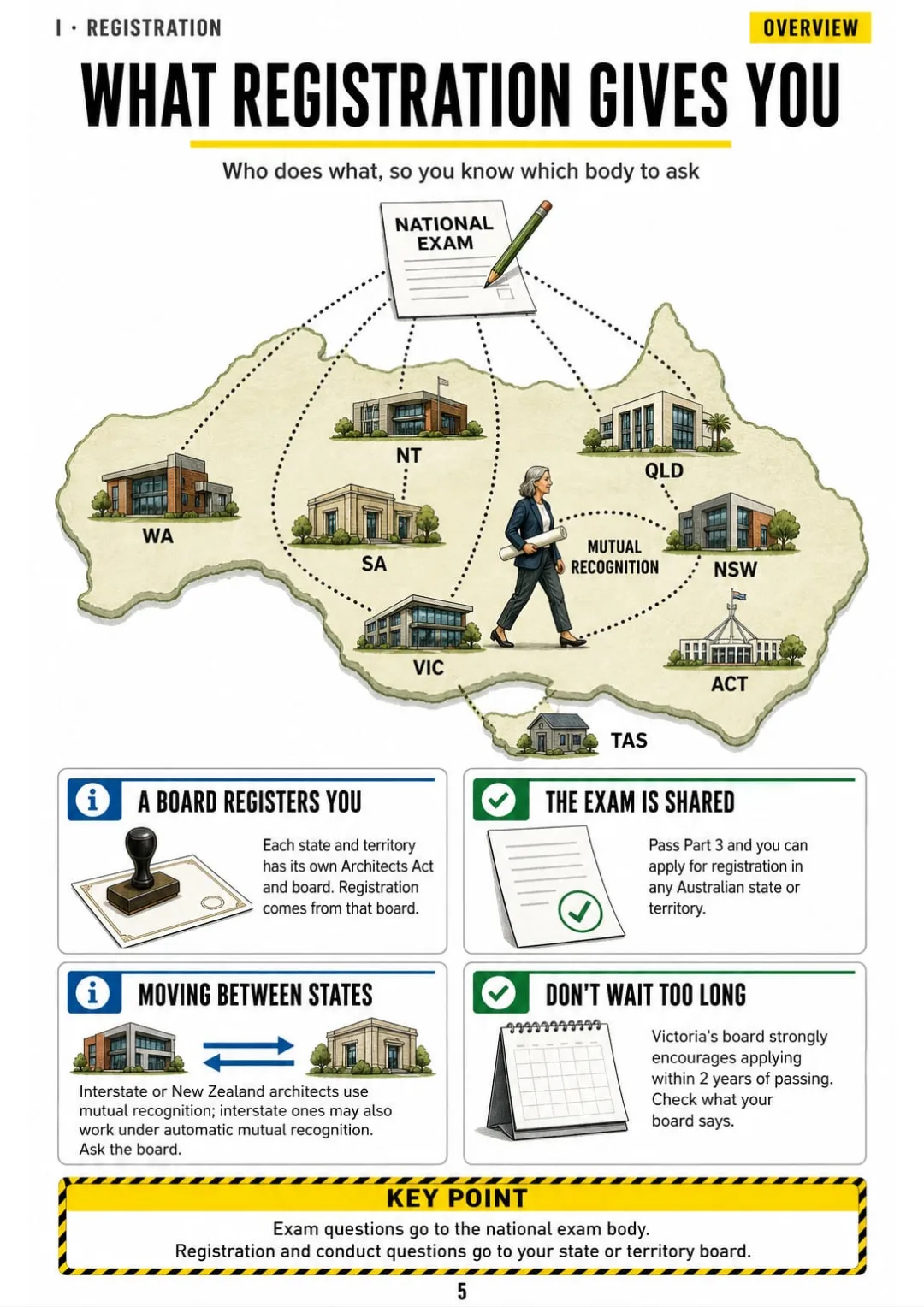
Pass Part 3 once, then apply to register in any Australian state or territory.
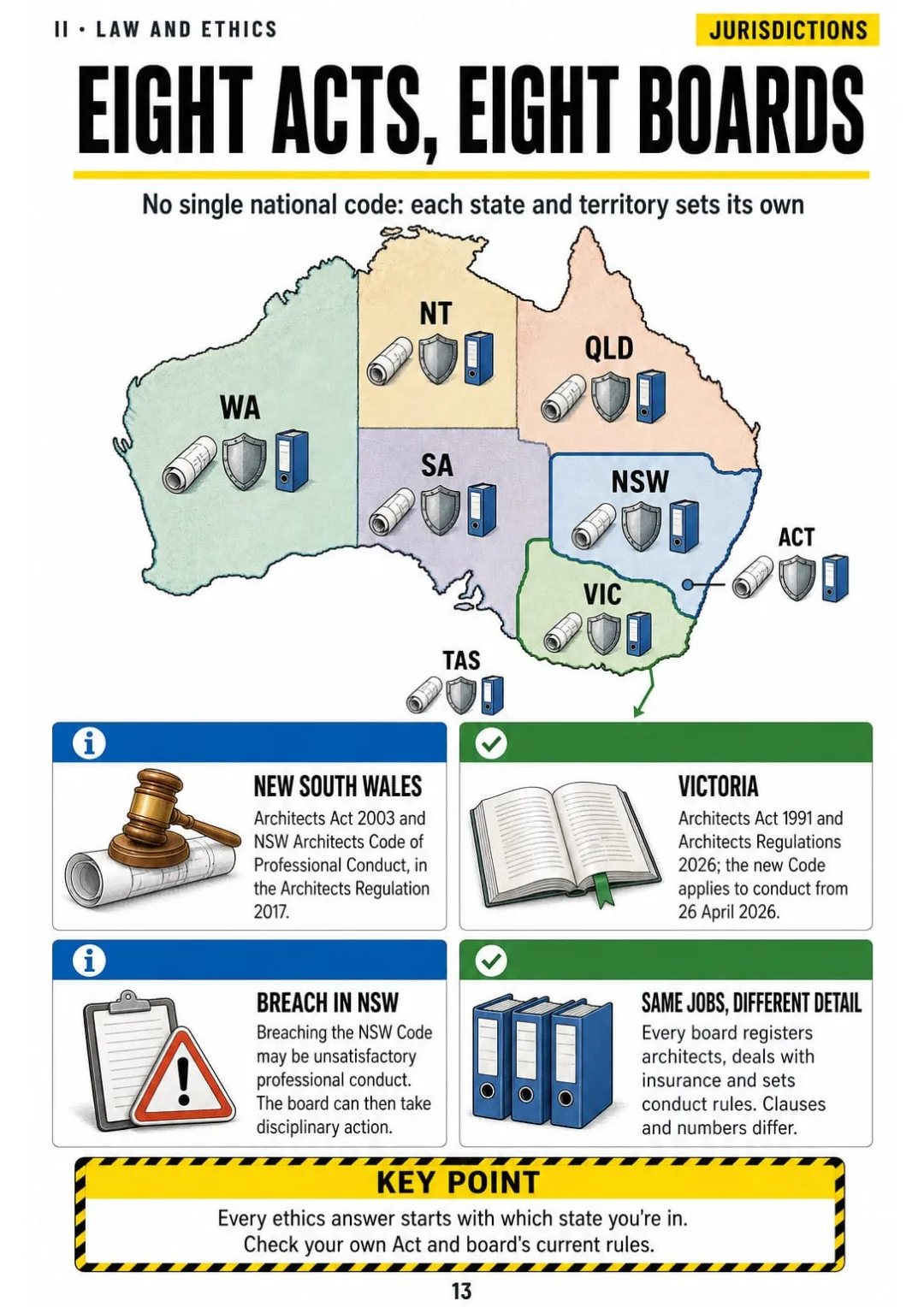
NSW: Architects Act 2003 · Victoria: Architects Act 1991 and Regulations 2026
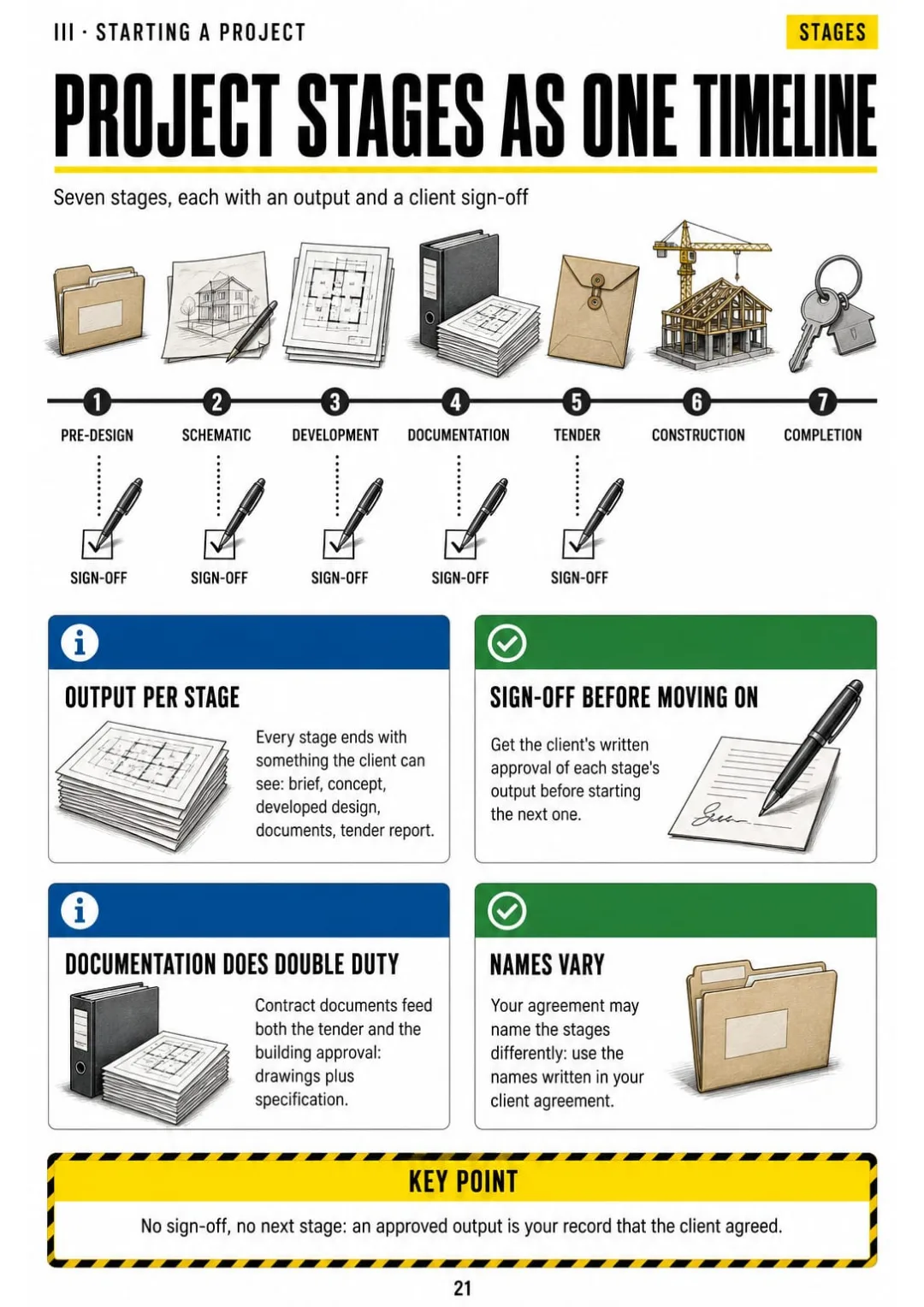
Seven project stages on one timeline, each with its output and sign-off point
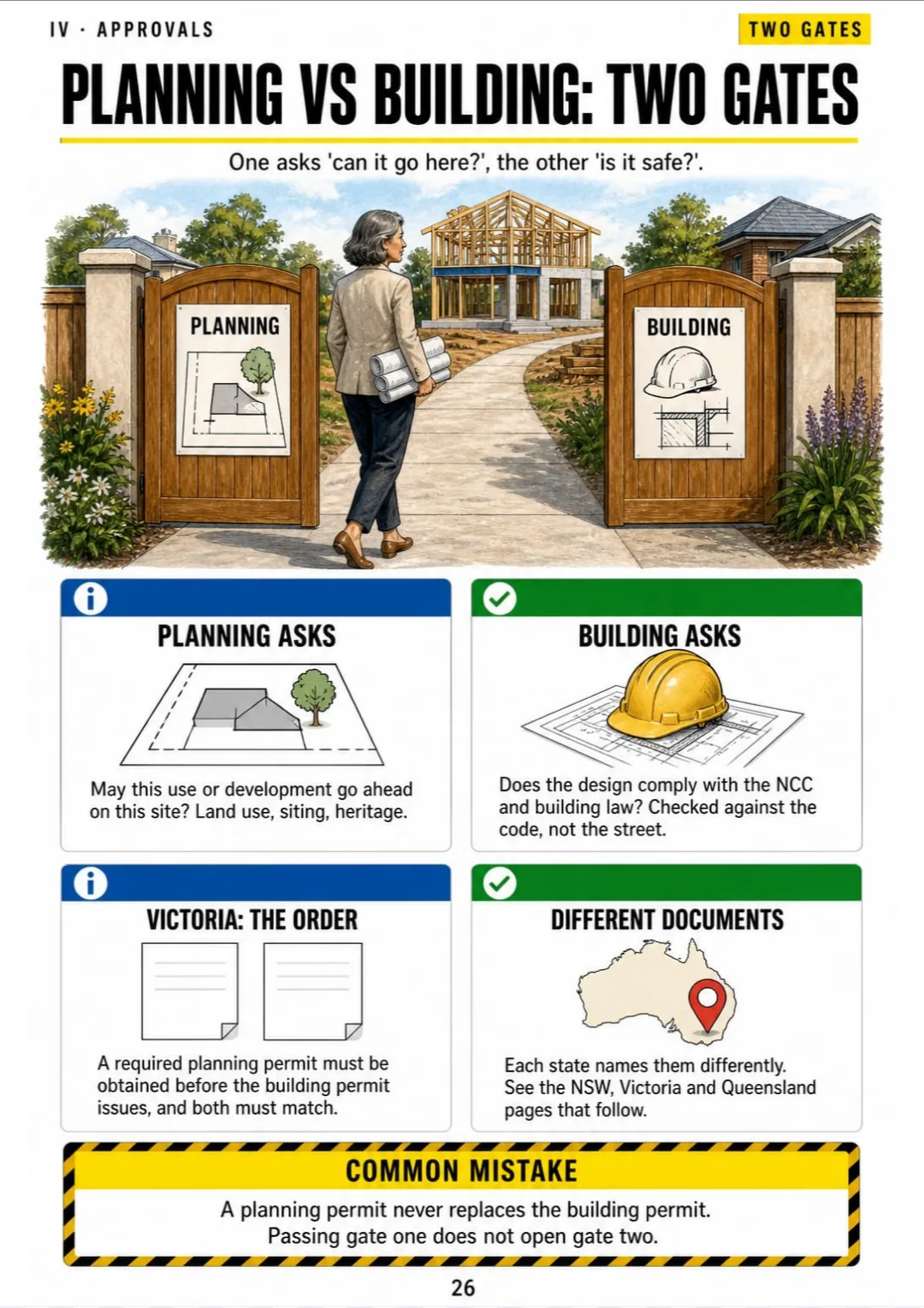
Planning approval ≠ building approval: two separate questions, usually two decisions and two documents.
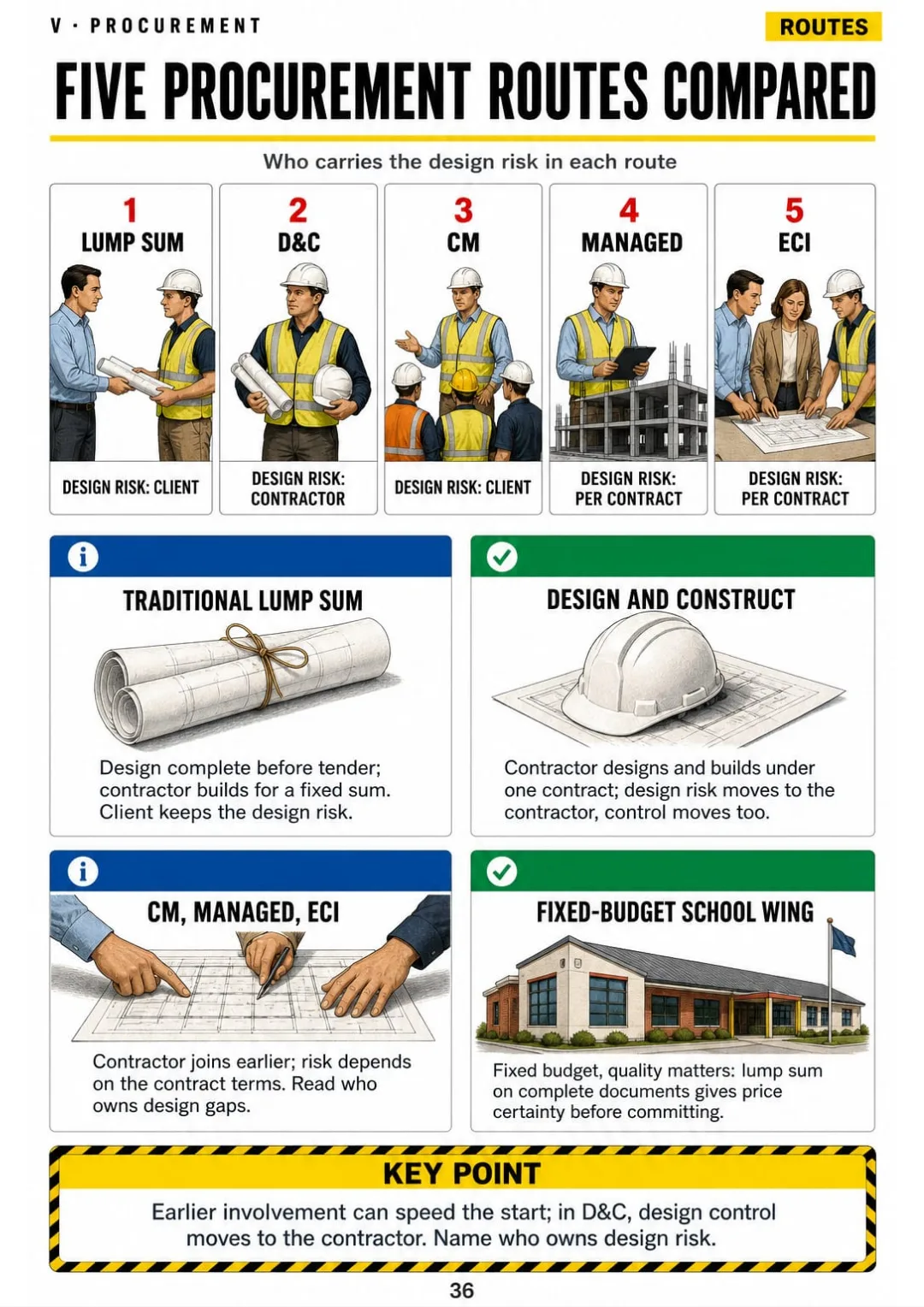
Lump sum, D&C, CM, managed contract and ECI: design risk side by side
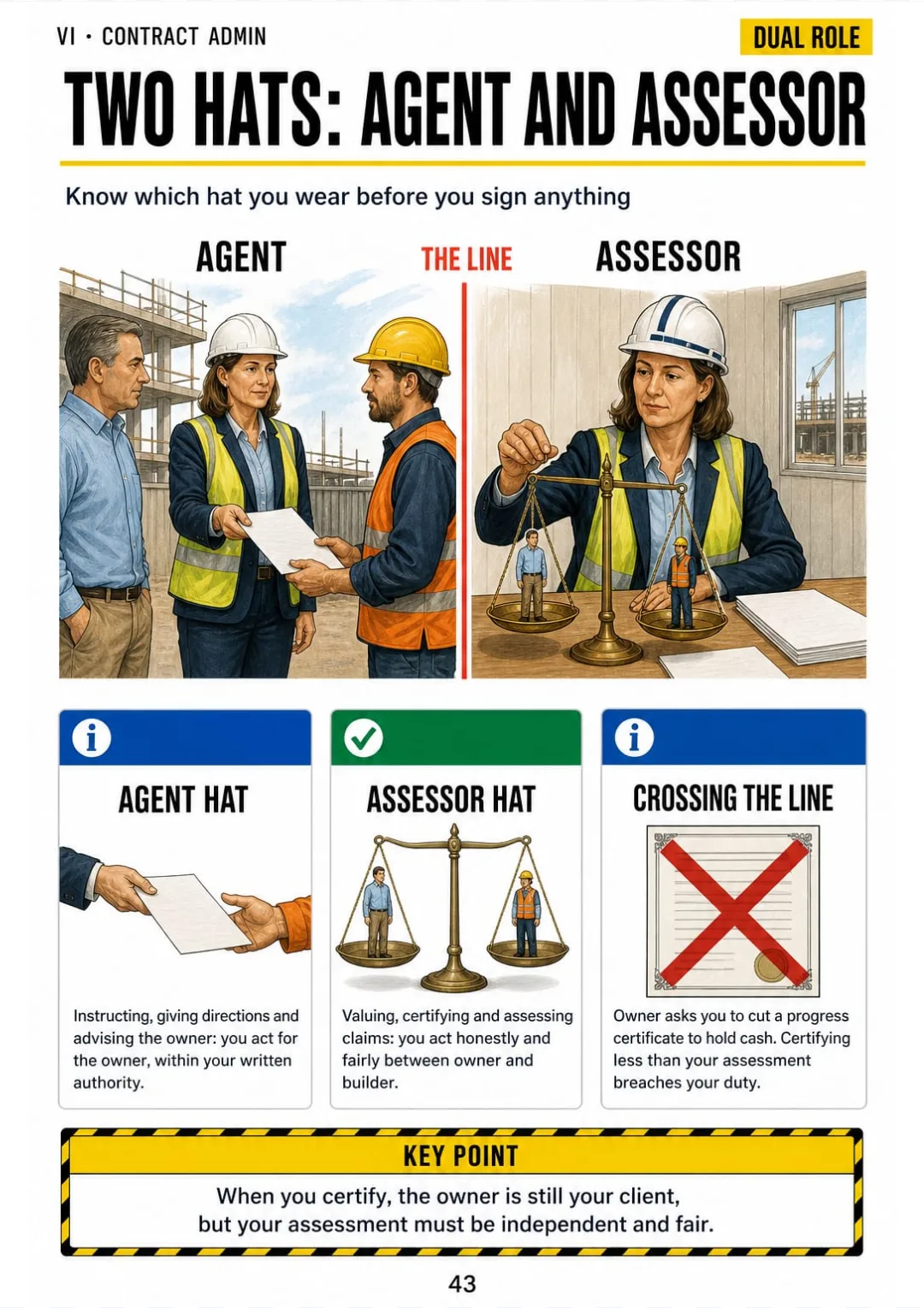
The dual role as two hats, with a worked example of crossing the line
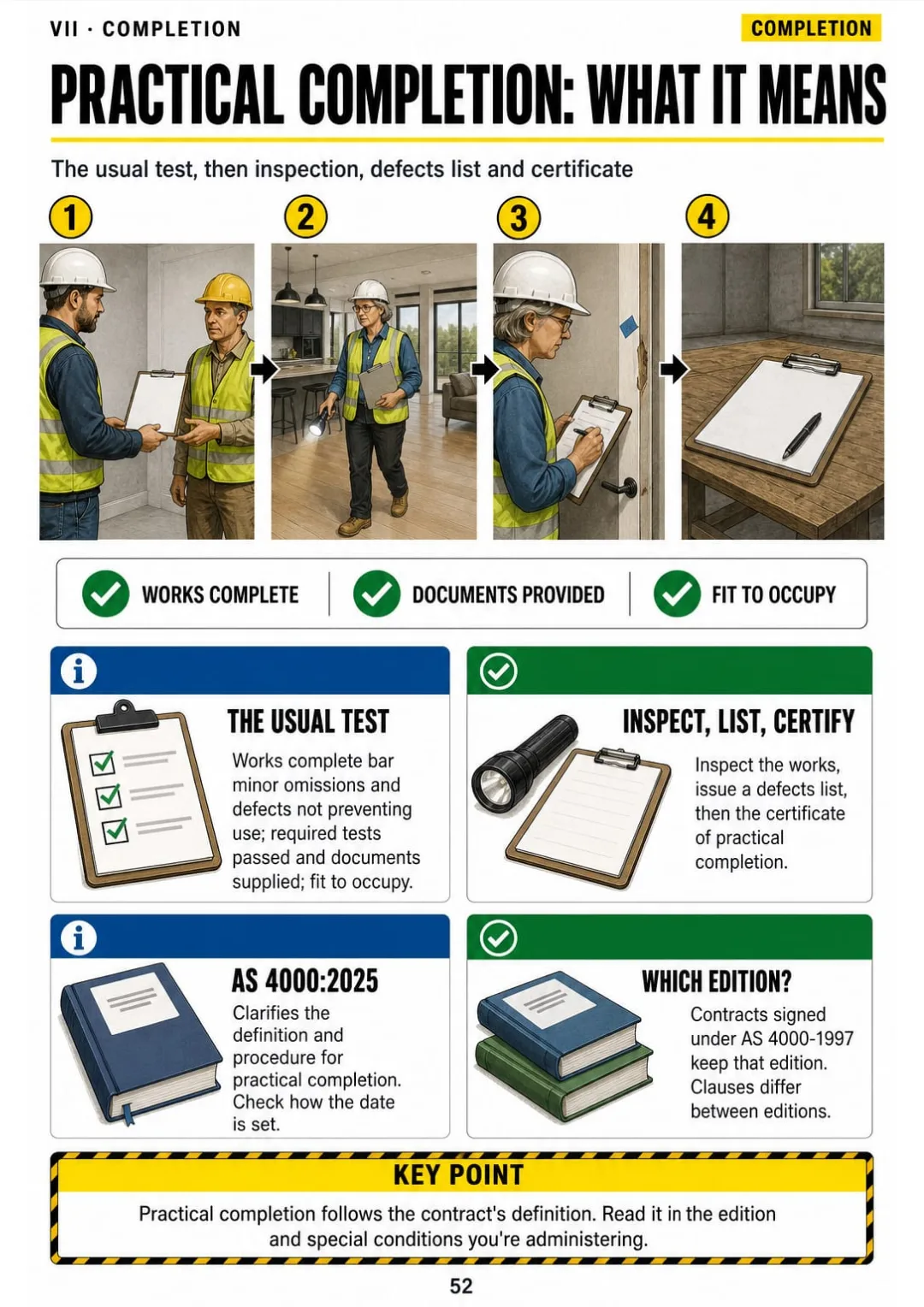
Practical completion: works complete, documents provided, fit to occupy → inspection → defects list → certificate.
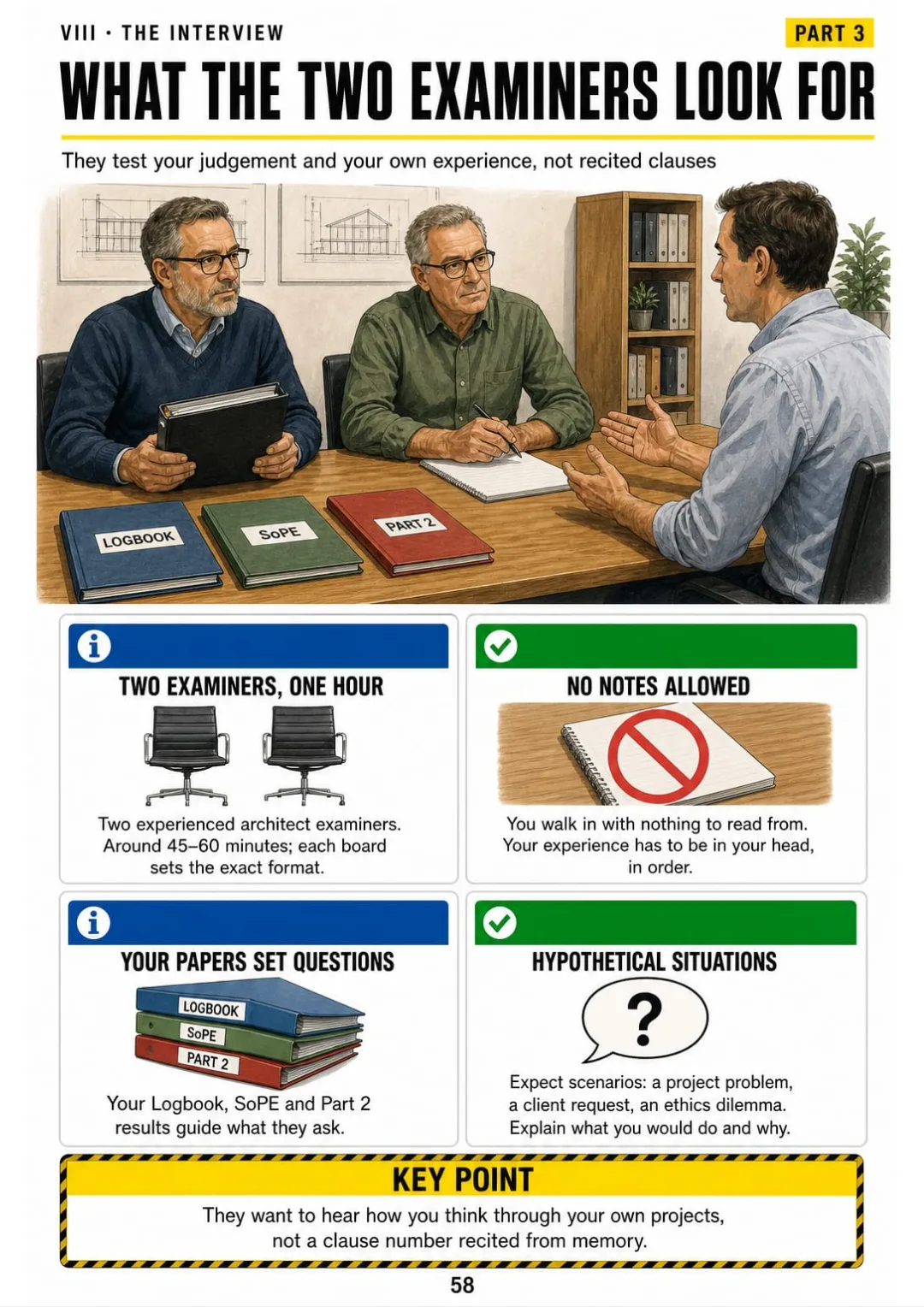
Part 3: two examiners, around 45–60 minutes, no notes, questions drawn from your Logbook and SoPE

Swipe to see more →

These are real pages from the book. The table of contents is the full one: 9 parts and 61 topics.

The Problem Isn't You. It's How It Was Explained to You.

You're sitting across from the two examiners. One of them asks you to take them through a project, stage by stage, and say what each stage produced and who signed it off. You've run every one of those stages on real jobs, and right now the order won't come.

The textbook covers project stages in paragraphs: one stage per section, the outputs in a list somewhere else, the sign-offs in another chapter. Nothing links each stage to what it produces and who approves it.

Seven project stages on one timeline, each with its output and sign-off point

In the book, project stages are one timeline across the page: seven stages from left to right, each with its output underneath and its sign-off point marked. You read it once, left to right, and the order stays with you.

Approvals, procurement, contract administration and practical completion work the same way: one page, one drawing.

In the interview, you tell your project in the same order as the page, calmly, and you don't need to go back to the textbook to check what comes next.

COMPARE FOR YOURSELF

The Same Topic, Two Ways to Study It

THIS
  • The textbook: line after line
  • Acts, boards and registration rules explained only in words
  • You walk into the exam still unsure
Architects in Australia are regulated under separate legislation in each state and territory. In New South Wales, the Architects Act 2003 establishes the registration board, while in Victoria the Architects Act 1991, together with its associated Regulations, provides for a separate board. Comparable statutes apply in Queensland, Western Australia, South Australia, Tasmania, the Australian Capital Territory and the Northern Territory, each specifying registration requirements, conduct obligations, disciplinary procedures, insurance provisions and the circumstances in which the title 'architect' may lawfully be used by individuals and corporate entities.
FOR THIS
  • Eight Acts and eight boards on one map
  • Each state's Act and board in its own box
  • You see it and you get it
NSW: Architects Act 2003 · Victoria: Architects Act 1991 and Regulations 2026
CONTENTS

Take a Look at the 9 Parts and 61 Topics

The path to registration, law and ethics, starting a project, approvals, procurement, contract administration, completion and defects, the interview and the review checklists: 65 pages, all illustrated.

IThe path to registration · pp. 5-12
  1. What registration actually gives you
  2. The three parts of the exam, in order
  3. Who is eligible: local and overseas pathways
  4. The competency standard on one page
  5. Logging your hours without losing any
  6. Writing the Statement of Practical Experience
  7. Checking the current exam format before you book
  8. A 12-week plan, counted back from your exam date
IILaw, ethics and running a practice · pp. 13-20
  1. Your state's Architects Act and board
  2. The code of professional conduct in five duties
  3. Conflicts of interest: declare, then decide
  4. Professional indemnity insurance and the nominated architect
  5. Continuing professional development
  6. Copyright and moral rights in drawings
  7. Negligence, duty of care and limitation periods
  8. Fees and the written client agreement
IIIStarting a project · pp. 21-25
  1. Project stages as one timeline
  2. From brief to feasibility
  3. Reading the site: title, easements and covenants
  4. Building the consultant team
  5. Managing scope creep in your own services
IVPlanning and building approvals · pp. 26-35
  1. Planning approval and building approval are two different things
  2. NSW: DA → CC → OC
  3. Victoria: planning permit → building permit → occupancy
  4. Queensland and the other states at a glance
  5. How the NCC is organised
  6. Deemed-to-Satisfy or Performance Solution
  7. Building classes 1 to 10, drawn
  8. Fire: types of construction and FRL
  9. Access for people with disability
  10. Energy efficiency: Section J and house ratings
VProcurement and documentation · pp. 36-42
  1. Procurement routes compared
  2. Choosing the building contract
  3. Contract documents and order of precedence
  4. Writing a specification that works
  5. The tender process step by step
  6. Evaluating tenders and accepting one
  7. Novation in design and construct
VIContract administration on site · pp. 43-51
  1. The architect as contract administrator
  2. Instructions: who can give them and how
  3. Variations: order, price, record
  4. Extensions of time are not variations
  5. Delay costs and liquidated damages
  6. Progress claims and certificates
  7. Security of payment: claim, schedule, adjudication
  8. Site meetings and records
  9. Disputes and insurance during construction
VIICompletion and defects · pp. 52-57
  1. Practical completion: what it means
  2. What changes on the day of practical completion
  3. The defects liability period
  4. Retention and security release
  5. Handover: the documents the owner receives
  6. Residential: statutory warranties and home building insurance
VIIIThe interview · pp. 58-61
  1. What the two examiners are looking for
  2. Telling a project in the same order every time
  3. Answering an ethics scenario
  4. When you don't know the answer
IXReview and checklists · pp. 62-65
  1. The five sequences on one page
  2. Terms candidates commonly mix up, side by side
  3. Checklist before the written paper
  4. Checklist before the interview

One Page, One Topic, All Clear

Think of it this way:

The written paper gives you a scenario: the owner asks for an extra window, and two weeks later the builder claims more time for rain. You need to know straight away which is the variation and which is the extension of time.

You open the page on extensions of time and see the two paths drawn side by side: instruction → variation → payment claim on one side, delay → notice → extension of time on the other. One look and the difference is plain.

Lump sum, D&C, CM, managed contract and ECI: design risk side by side

Same with planning and building approval in your state, the five procurement routes, practical completion and the defects liability period, the code of conduct in five duties and the interview: each one has its own page.

Architectural Practice Illustrated is 65 illustrated pages in 9 parts, one topic per page, finishing with the five sequences on one page and the checklists for the written paper and the interview.

What you see drawn, you don't have to memorize.

What's Inside Architectural Practice Illustrated:

Ipp. 5-12

The path to registration

What registration gives you, the three parts of the exam, local and overseas pathways, the competency standard, logging hours, the Statement of Practical Experience and a 12-week plan.

IIpp. 13-20

Law, ethics and running a practice

Your state's Architects Act and board, the code of conduct in five duties, conflicts of interest, PI insurance, CPD, copyright, negligence and the written client agreement.

IIIpp. 21-25

Starting a project

Project stages as one timeline, brief to feasibility, title, easements and covenants, the consultant team and scope creep in your own services.

IVpp. 26-35

Planning and building approvals

Planning vs building approval, NSW, Victoria, Queensland and the other states, how the NCC is organised, DTS or Performance Solution, building classes, fire, access and energy efficiency.

Vpp. 36-42

Procurement and documentation

Procurement routes compared, choosing the contract, order of precedence, specifications, tendering, evaluating tenders and novation in design and construct.

VIpp. 43-51

Contract administration on site

The contract administrator's role, instructions, variations, extensions of time, delay and liquidated damages, progress claims, security of payment, site records and disputes.

VIIpp. 52-57

Completion and defects

What practical completion means and what changes on the day, the defects liability period, retention, handover documents and residential warranties and insurance.

VIIIpp. 58-61

The interview

What the two examiners look for, telling a project in the same order, answering an ethics scenario and what to do when you don't know.

IXpp. 62-65

Review and checklists

The five sequences on one page, terms commonly mixed up side by side, and checklists before the written paper and the interview.

At the end of the book: A review part with the five sequences on one page, commonly mixed-up terms side by side and checklists before the written paper and the interview.
Plus: 2 Free Books

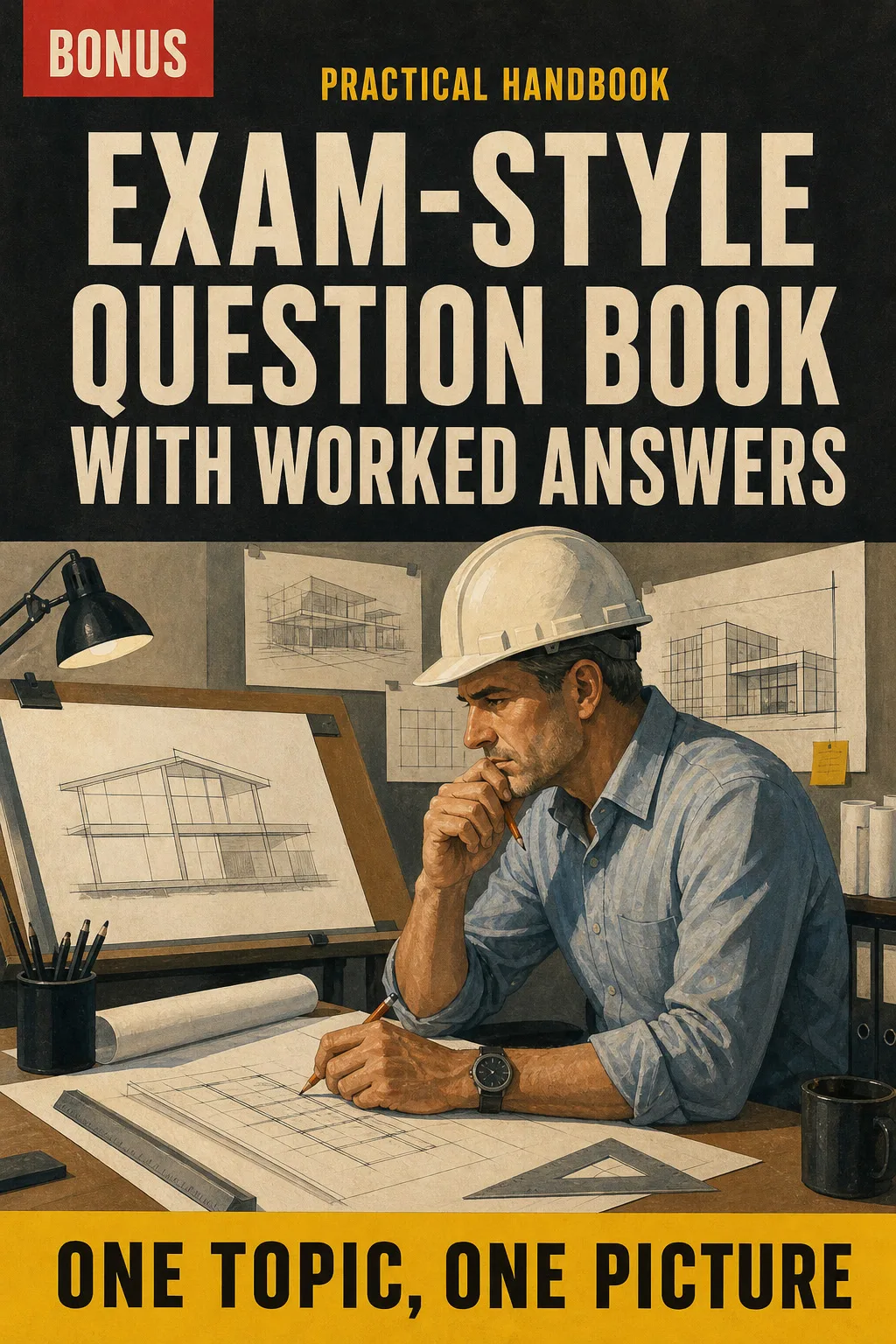
Exam-Style Question Book with Worked Answers

BONUS 1: «Exam-Style Question Book with Worked Answers»

Value on its own: US$ 17.90

Practise the written paper with exam-style questions on contracts, approvals and ethics, each answer explained with a reference to the page where the topic is drawn.

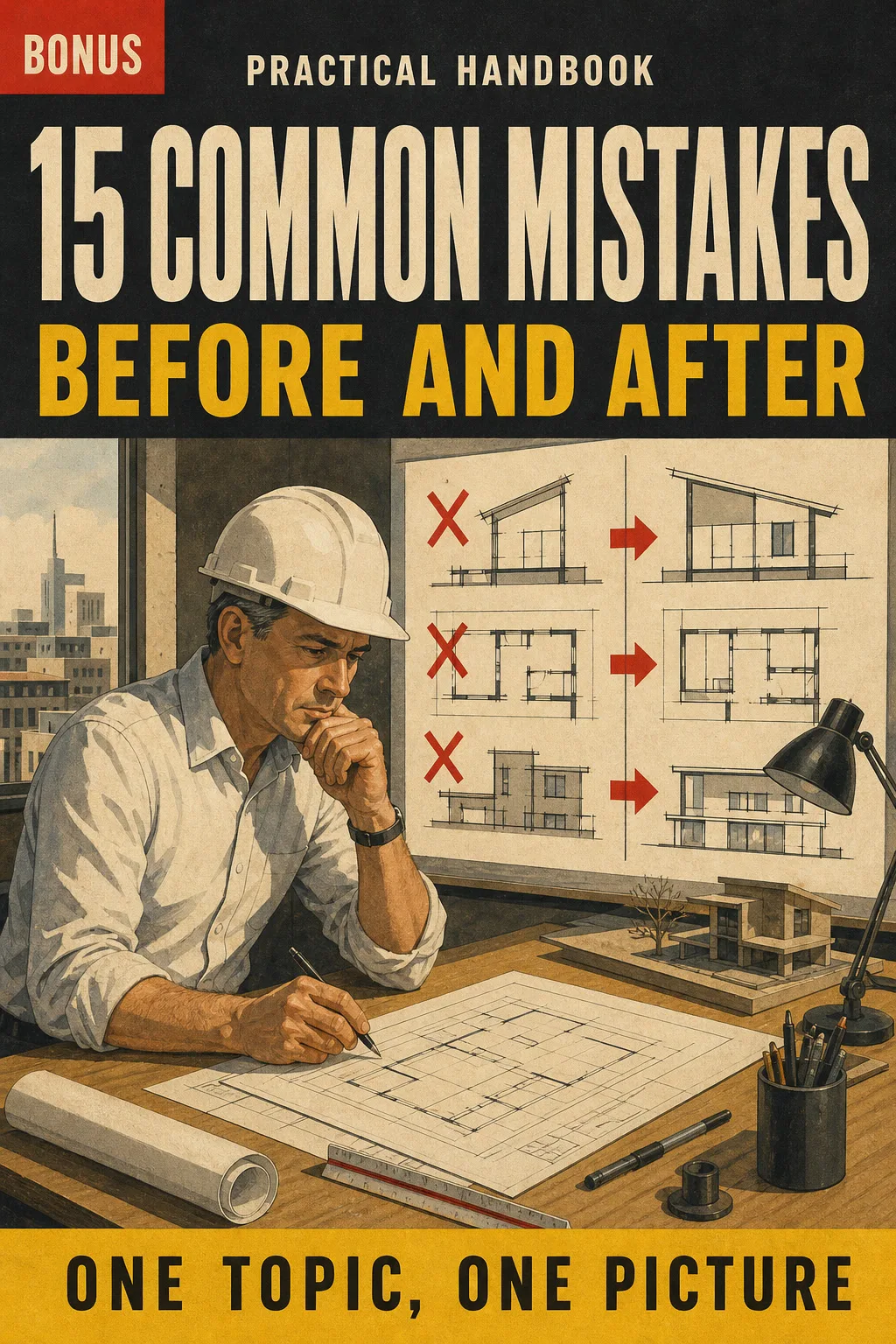
15 Common Mistakes: Before and After

BONUS 2: «15 Common Mistakes: Before and After»

Value on its own: US$ 14.90

Review the mistakes candidates make most often, from mixing up variations and extensions of time to recording logbook hours, each one drawn wrong and then right.

Architectural Practice Illustrated with 2 Free Books

  • Architectural Practice Illustrated: 65 illustrated pagesUS$ 63
  • BONUS 1: Exam-Style Question Book with Worked AnswersUS$ 17.90
  • BONUS 2: 15 Common Mistakes: Before and AfterUS$ 14.90
  • High-resolution PDF to printIncluded
Total value US$ 95.80
YOUR PRICE:
US$ 27
You save US$ 68.80
YES, I WANT ARCHITECTURAL PRACTICE ILLUSTRATED FOR US$ 27

📄 This is a digital PDF book sent to your email: nothing is printed or shipped.

Secure purchaseEncrypted payment30-day guarantee

PDF by email: We email you Architectural Practice Illustrated as a PDF, together with the two free books. It's a single payment: no installments, no extra charges.

Who This Book Is For

You're logging your hours

You're logging your hours

You see which competency each project covers, so your logbook and Statement of Practical Experience come from real work, not guesswork.

Your exam is coming up

Your exam is coming up

Contracts, approvals and ethics in fixed sequences you can review at night, one page at a time, plus exam-style questions with worked answers.

You've practised for years without registering

You've practised for years without registering

What you already do on site, put in order and drawn, so you can explain it calmly to two registered architects.

Everything You Get Today

US$ 95.80US$ 27
YES, I WANT ARCHITECTURAL PRACTICE ILLUSTRATED FOR US$ 27

📄 This is a digital PDF book sent to your email: nothing is printed or shipped.

30DAYS
GUARANTEE

30-Day Guarantee

Try Architectural Practice Illustrated for 30 days, bonus books included.

We refund everything if the file won't open, if the book isn't what you see here, if you were charged twice or if the email doesn't arrive. Just email us.

You pay once. No subscriptions.

Frequently Asked Questions

Is it for me if I've worked in a practice for years and never registered?

Yes. It doesn't start from zero: it puts what you already do on site into order, one topic per page, so you can explain it in the exam and the interview.

Is it up to date for my state and the current exam?

It's built on the National Standard of Competency for Architects and the APE Candidate Handbook, the NCC, each state and territory's Architects Act and code of conduct, state planning, building and security of payment laws, and the standard contract forms. Approvals and security of payment are drawn for NSW, Victoria and Queensland, with WA, SA, Tasmania, the ACT and the NT compared side by side. The written paper's format and booking can change: the book covers what the exam assesses, not the booking or the question format, so check the current Candidate Handbook on the official website. Every time limit is flagged for you to check.

Is it official material?

No. It's an independent study book and isn't affiliated with or endorsed by the AACA, any architects board or any standards body.

Does it replace a preparation course or your practical experience?

No. It's a study and review companion: it doesn't give you a certificate or CPD points. Your logbook hours, your experience and the official sources still come first.

Are the practice questions the ones in the exam?

No. The exam-style questions are written for this book. They're for practice, and they aren't official exam questions.

When and how does it arrive?

The book and the 2 bonus books come as a PDF by email, sent to the address you enter when you pay.

Do I have to pay every month?

No. It's a one-off payment, with no subscription.

Can I have it on paper?

Yes. It's a PDF you can print, whole or page by page, and keep at the office or on your desk.

How does the refund work?

You have 30 days. We refund everything if the file won't open, if the book isn't what you see on this page, if you were charged twice or if the email doesn't arrive: just email us.

Before You Close This Page

No more rereading with nothing sticking.

Project stages, approvals and contracts: you see them drawn, and you've got them.

You walk into the written paper and the interview knowing where everything is.

Drawings make studying faster.

The book is right below.

One-time payment: US$ 27 · Guarantee: 30 days · PDF by email

YES, I WANT ARCHITECTURAL PRACTICE ILLUSTRATED FOR US$ 27

📄 This is a digital PDF book sent to your email: nothing is printed or shipped.